Women and poverty: Facts, figures, and closing the gap
Mar 4, 2026
We often hear that the face of poverty is a woman. But what does that actually mean?
Women are more likely than men to live in extreme poverty, for a number of reasons. They’re also likely to face unique challenges (especially once they become mothers), that can not only impact their lives, but the lives of their children and extended families.
Here’s what you need to know about women and poverty—including what Concern is doing to close the gap.
Women and poverty, by the numbers
Since 2020, roughly 10% of the world’s women have lived below the international poverty line. UN Women reported last September that, if current trends continue, 351 million women and girls could still be living in extreme poverty by 2030.
These rates are higher in key areas, particularly sub-Saharan Africa where more than 3 out of every 10 women live in poverty, and in conflict zones where women are 670% more likely to face poverty as well.
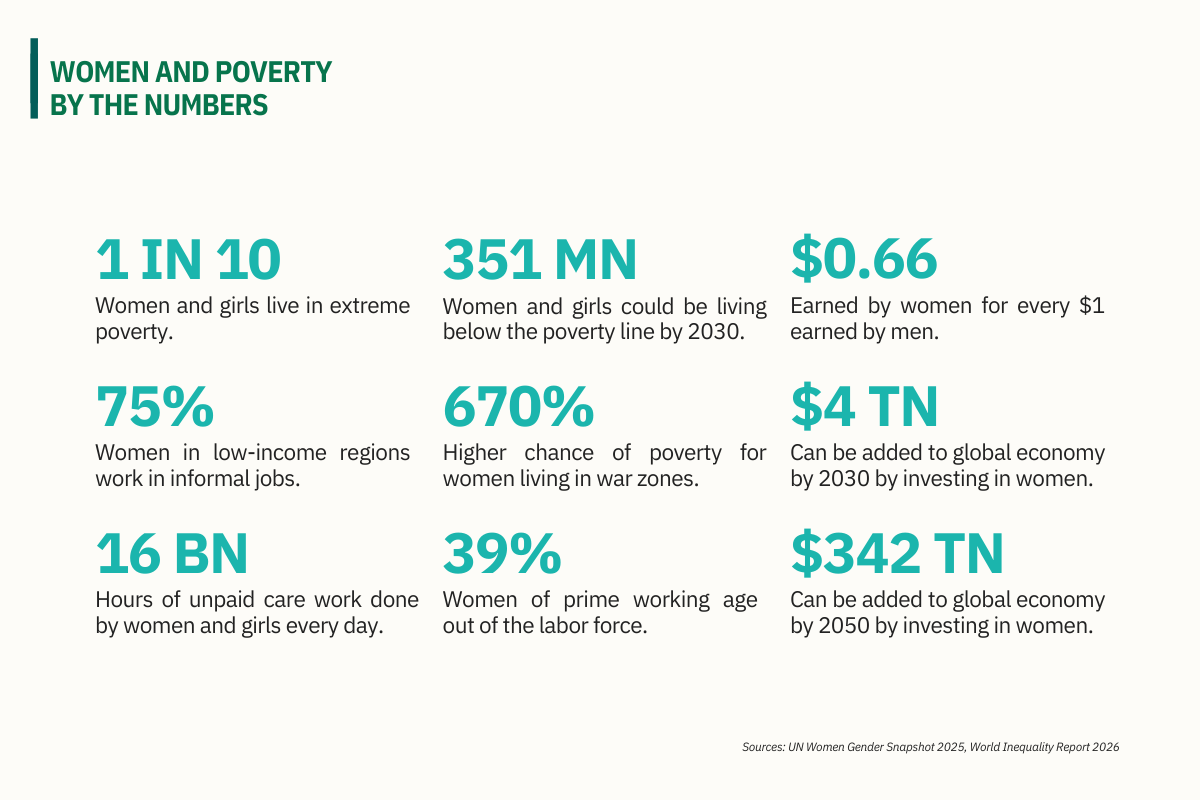
The good news: If we’re able to accelerate our work towards ending poverty with proven solutions, we could cut global extreme poverty among women from 9.2% in 2025 to 2.7% in 2050.
What’s more, investing in this work could add as much as $4 trillion to the global economy by 2030—and an additional $342 trillion cumulatively by 2050.
Why are women more likely to be in poverty?
None of this is random, and there are several reasons that leave women more frequently caught in the cycle of poverty. Here are five of the most common issues that millions of women face around the world.
1. The gender pay gap
Globally, women earn 34% less than men, meaning that for every $1 men take home, women take home $0.66 for the same amount of work.
2. Fewer job opportunities and resources
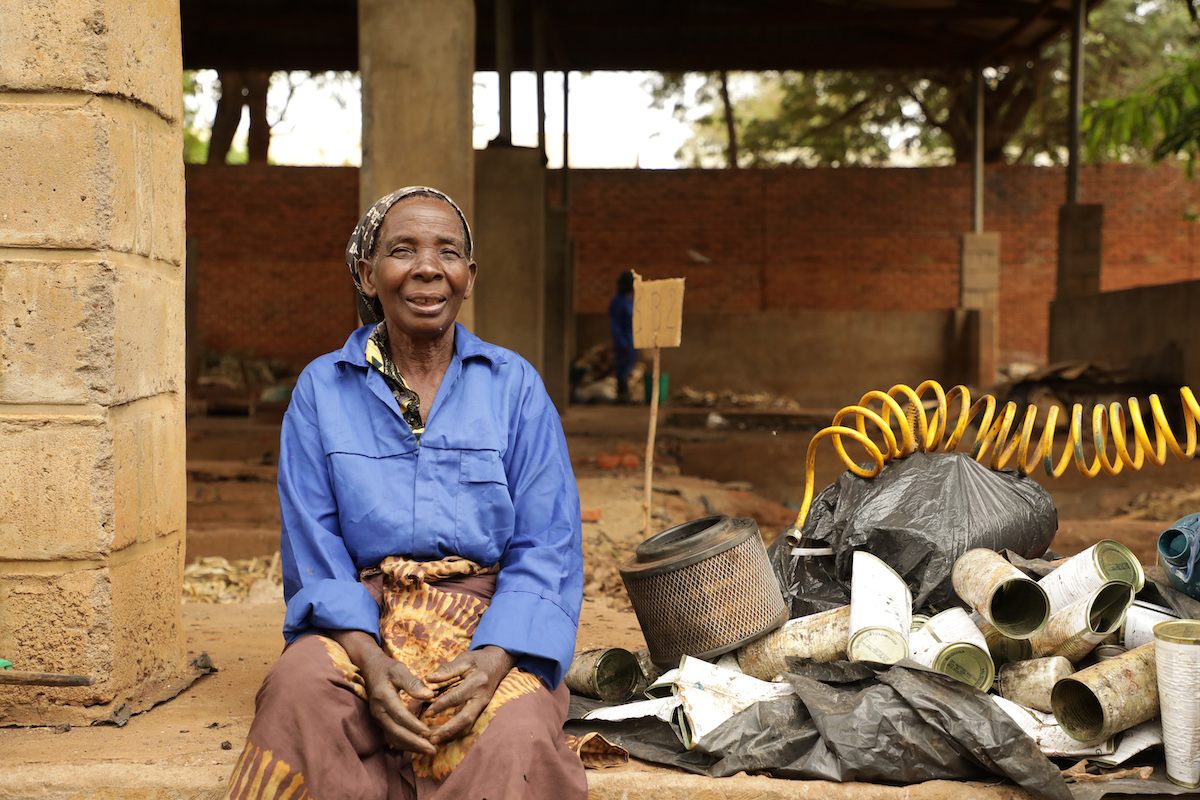
One reason many women take home less than men is the type of work they’re able to get. In low- and lower-middle income regions of the world, 75% of women work in the informal economy. This means they have fewer job protections, are likely to be uncontracted, lack legal rights in the workplace, and are underpaid.
Part of this is because girls are often less likely to finish school, limiting their education levels and future opportunities. In many countries, women are still prevented from owning land or accessing credit that could be used as additional economic resources.
3. Higher unemployment rates
Many women who are of prime workforce age are out of the labor market at a disproportionate rate compared to men. For two out of every three of these women (about 379 million in total), the reason is simple: They don’t have access to affordable childcare.
4. Unpaid care work
Every day, women and girls do 16 billion hours of unpaid care work that is critical to families and communities. However, it also comes at a cost of roughly $10.8 trillion (yes, trillion) per year for the global economy. For some countries, this unpaid work—if counted—could make up as much as 40% of the GDP.
5. War and conflict
In 2024 (the most recent year for complete data), 676 million women and girls lived within 30 minutes of the frontlines of conflict—the highest number in decades. Women are also 7.7 times more likely to live in extreme poverty when they also live in a conflict zone.
How does poverty affect women?
Poverty isn’t an equal-opportunity problem, and women often experience effects that men (and even children, who are also more vulnerable) don’t.
1. Hunger
When there isn’t enough food to go around, women usually eat last, prioritizing men and their children over their own needs. Over time, however, this can lead to a number of health complications and also reduce a woman’s capacity to study or work.
2. Maternal mortality
Women living in poverty are often unable to get quality medical care, especially while they’re pregnant. In fact, the UN Population Fund reports that “maternal mortality rates reflect disparities between wealthy and poor countries more than any other measure of health.”
Chad has one of the highest maternal mortality rates in the world (748 deaths for every 100,000 live births). Compare this to the global average (197 deaths for every 100,000 live births), or the average for the United States (17 deaths for every 100,000 live births).
3. Barriers to education
Education is one of the greatest tools a person has to escape poverty. However, poverty can also prevent children from getting into the classroom. If a family has to choose, it will also more likely send its boys to class than its girls. This adds up: Not investing in girls’ education is costing the global economy over $10 trillion per year.
4. Violence against women and girls
Crises that contribute to poverty—like conflict and natural disasters—also increase the chances of violence against women and girls. UN Women reports that 70% of women caught in a humanitarian crisis experience violence, while only 35% of women experience this in non-crisis situations. Poverty may also leave parents more likely to force their daughters into early marriage to reduce their financial burden.
5. Informal labor exploitation
With as many as 75% of women employed in informal economies in developing countries, exploitation can have some significant ripple effects in many countries. Without adequate rights and protections, women are more likely to be caught in poor and underpaid working conditions without a way to get out.
Where are women’s poverty rates the highest?
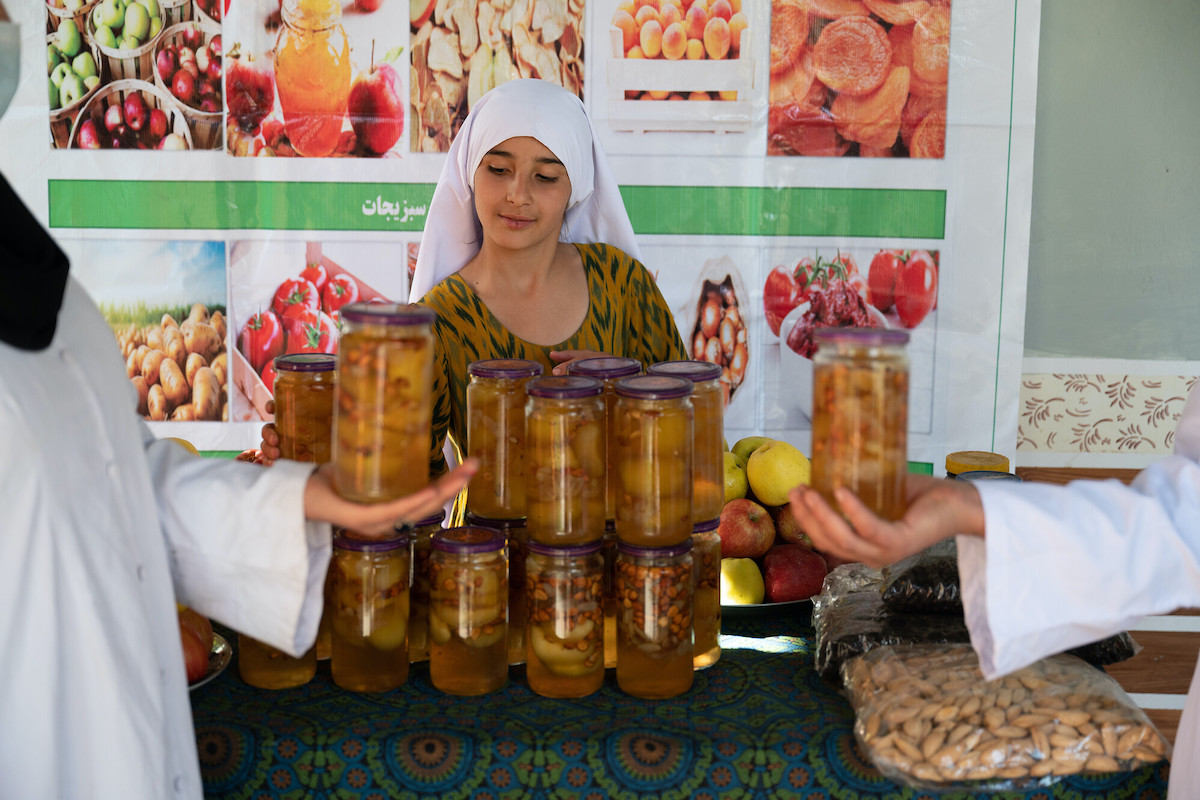
Of the 401 million women living in poverty, more than 295 million live in sub-Saharan Africa (an additional 35.5 million live in the Middle East and North Africa and 32.3 million live in South Asia).
This includes many of the countries where Concern works, for a number of reasons: Countries with the highest rates of women’s poverty also tend to be countries in conflict, countries with high hunger rates, and countries that are vulnerable to climate risks. Many of these countries are coping with all three of these crises—and more—at the same time.
Learn more about some of these countries with high poverty rates for women, and how we’re helping.
How is Concern working to fight poverty among women and girls?
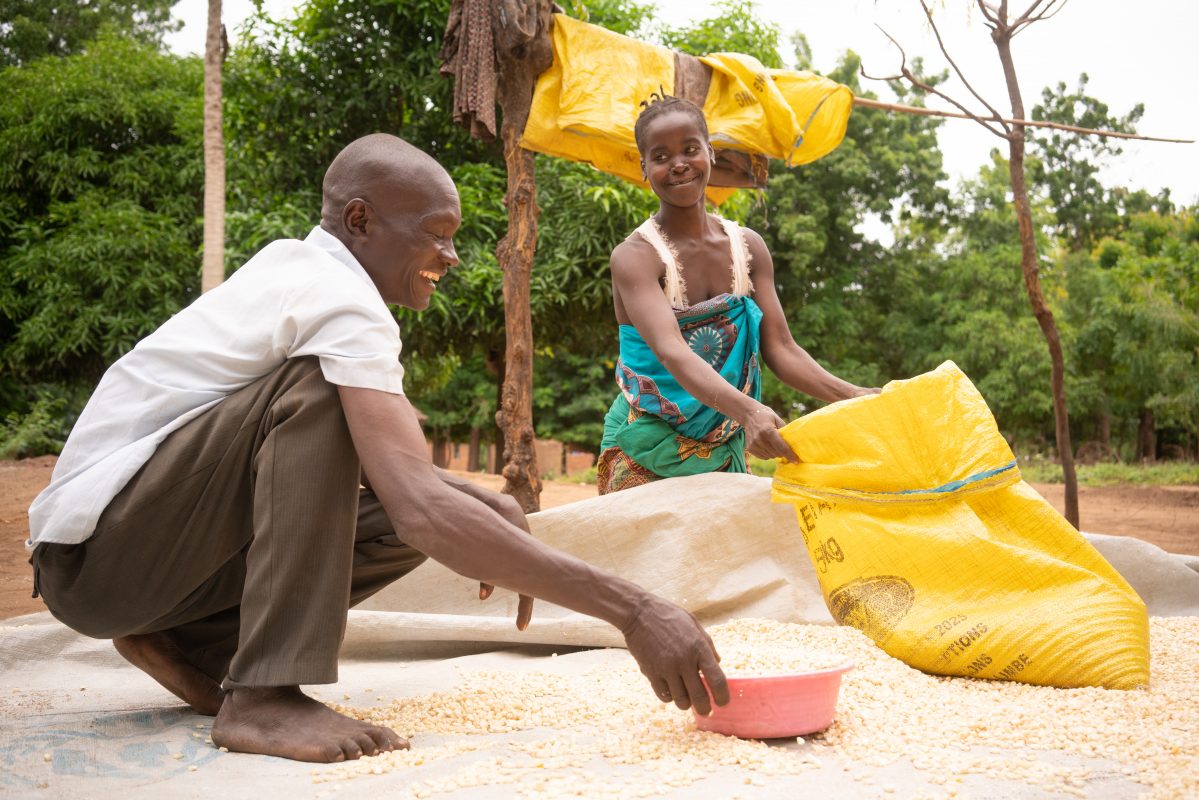
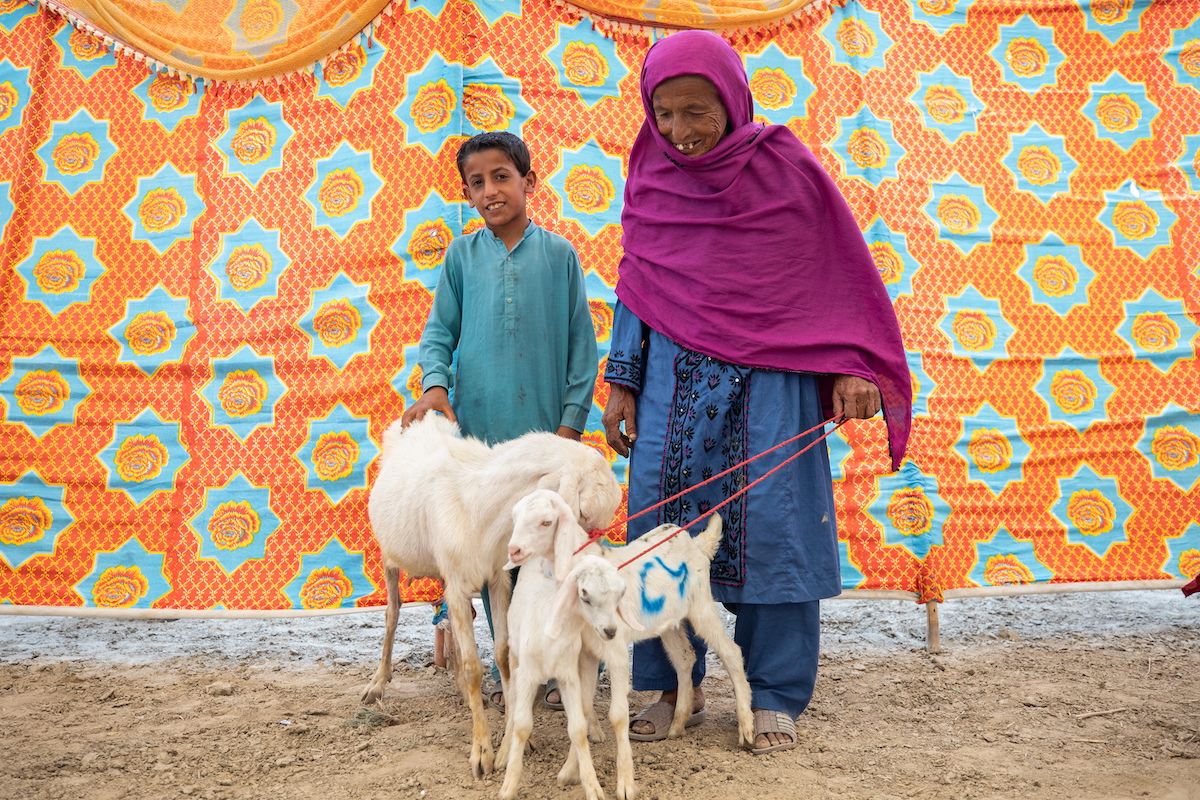
Economically empowering women is not just an answer to poverty among women and girls, but poverty in general. When women work, economies grow.
There are some barriers to this that require major shifts; we can’t end conflict by ourselves and one 2023 report from the World Bank shows that 69% of countries still have laws that restrain women’s decisions to work. But there’s still a lot we can do to give women the access they need to skills, resources, and support—both from Concern and within their own community.
Through some of our flagship programs like Graduation, we work with thousands of families each year, many of them female-headed and many headed by couples who learn to work together for a shared future. Village Savings and Loans Associations (VSLAs) are another tried-and-true way to make financial resources accessible to women, including low-interest loans and lines of credit.
Women and poverty: Concern’s response
Across the countries where Concern works, women and girls living in extreme poverty face hunger, crises, and limited resources. Yet, when they have access to skills, opportunities, and support, their lives improve. Economies grow. Entire communities are better for it.
Concern’s Women & Girls Fund allows our teams to provide the tools needed for success, including:
- Expanding access to skills training and income opportunities
- Strengthening family nutrition, health, and wellbeing
- Supporting women-led collective action and community solutions
Because the fund is flexible, it allows Concern to invest where women and girls are driving change, adapt programs as needs evolve, and support solutions that deliver lasting impact across families and communities.
100% of your tax-deductible gift to Concern’s Women & Girls Fund goes to support programs that equip women and girls living in extreme poverty with the resources and opportunities to lead change.